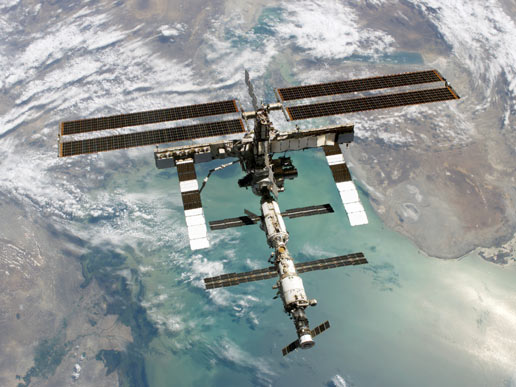
The International Space Station. Credit: NASA

Sunday, September 9, 2012

THE SONG OF MARS

PHOTO: GAIL CRATER ON MARS. CREDIT: NASA/ JPL/ CALTECH
 
FROM: NASA

Curiosity Rover Plays First Song Transmitted From Another Planet

PASADENA -- For the first time in history, a recorded song has been beamed back to Earth from another planet. Students, special guests and news media gathered at NASA's Jet Propulsion Laboratory (JPL) in Pasadena, Calif., today to hear "Reach for the Stars" by musician will.i.am after it was transmitted from the surface of Mars by the Curiosity rover.

NASA Administrator Charles Bolden addressed the crowd in a video message encouraging students to study science, technology, engineering and math (STEM). "Mars has always fascinated us, and the things Curiosity tells us about it will help us learn about whether or not life was possible there," Bolden said. "And what future human explorers can expect. will.i.am has provided the first song on our playlist of Mars exploration."

In opening remarks, NASA Associate Administrator for Education and space shuttle astronaut Leland Melvin said, "I can think of no greater way to honor NASA pioneer Neil Armstrong's life and legacy than to inspire today's students to follow his path. That first footprint that Neil placed on the lunar surface left an indelible mark in history. Perhaps one of our students here today or watching on NASA Television will be the first to set foot on the surface of Mars and continue humanity's quest to explore."

Musician and entrepreneur will.i.am shared his thoughts about "Reach for the Stars" becoming the first interplanetary song and an anthem for NASA education. The entertainer is a well-known advocate of science and technology education. He said, "Today is about inspiring young people to lead a life without limits placed on their potential and to pursue collaboration between humanity and technology through STEAM education. I know my purpose is to inspire young people, because they will keep inspiring me back."

After completing a journey of more than 300 million miles from Earth to Mars and back, the opening orchestral strains of "Reach for the Stars" filled the auditorium. The event added to continuing worldwide interest in Curiosity's mission.

NASA engineers spoke to attendees about the Curiosity mission, and the systems engineering and orbital mechanics involved in getting the song file back from Mars. Students had the opportunity to ask questions of all program participants. Earlier in the day, students received a guided tour of JPL to view rover models and learn about STEM career options.

During the event, will.i.am's i.am angel Foundation and Discovery Education announced a $10 million classroom education initiative that will reach 25 million students annually, including many from underserved communities. Focused on STEAM (science, technology, engineering, arts and mathematics) educational themes, the Discovery Education initiative will incorporate NASA content and space exploration themes as part of the curriculum.

Sunday, September 2, 2012

Sunday, August 26, 2012

AFSPC Milestone: AFSPC assumes resource management of multiple space systems

AFSPC Milestone: AFSPC assumes resource management of multiple space systems

SBSS gains operational capability

SBSS gains operational capability

Le Directeur Général de l’ESA, Jean Jacques Dordain, rend hommage à Neil Armstrong

Le Directeur Général de l’ESA, Jean Jacques Dordain, rend hommage à Neil Armstrong

FIRST MAN ON THE MOON PASSES AWAY

FROM:  NASA
John H. Glenn Research Center
Lewis Field
Cleveland, Ohio 44135

Neil A. Armstrong, the first man to walk on the moon, was born in Wapakoneta, Ohio, on August 5, 1930. He began his NASA career in Ohio.

After serving as a naval aviator from 1949 to 1952, Armstrong joined the National Advisory Committee for Aeronautics (NACA) in 1955. His first assignment was with the NACA Lewis Research Center (now NASA Glenn) in Cleveland. Over the next 17 years, he was an engineer, test pilot, astronaut and administrator for NACA and its successor agency, the National Aeronautics and Space Administration (NASA).

As a research pilot at NASA's Flight Research Center, Edwards, Calif., he was a project pilot on many pioneering high speed aircraft, including the well known, 4000-mph X-15. He has flown over 200 different models of aircraft, including jets, rockets, helicopters and gliders.

Armstrong transferred to astronaut status in 1962. He was assigned as command pilot for the Gemini 8 mission. Gemini 8 was launched on March 16, 1966, and Armstrong performed the first successful docking of two vehicles in space.

As spacecraft commander for Apollo 11, the first manned lunar landing mission, Armstrong gained the distinction of being the first man to land a craft on the moon and first to step on its surface.

Armstrong subsequently held the position of Deputy Associate Administrator for Aeronautics, NASA Headquarters,

Washington, D.C. In this position, he was responsible for the coordination and management of overall NASA research and technology work related to aeronautics.

He was Professor of Aerospace Engineering at the University of Cincinnati between 1971-1979. During the years 1982-1992, Armstrong was chairman of Computing Technologies for Aviation, Inc., Charlottesville, Va.

He received a Bachelor of Science Degree in Aeronautical Engineering from Purdue University and a Master of Science in Aerospace Engineering from the University of Southern California. He holds honorary doctorates from a number of universities.

Armstrong was a Fellow of the Society of Experimental Test Pilots and the Royal Aeronautical Society; Honorary Fellow of the American Institute of Aeronautics and Astronautics, and the International Astronautics Federation.

He was a member of the National Academy of Engineering and the Academy of the Kingdom of Morocco. He served as a member of the National Commission on Space (1985-1986), as Vice-Chairman of the Presidential Commission on the Space Shuttle Challenger Accident (1986), and as Chairman of the Presidential Advisory Committee for the Peace Corps (1971-1973).

Armstrong was decorated by 17 countries. He was the recipient of many special honors, including the Presidential Medal of Freedom; the Congressional Gold Medal; the Congressional Space Medal of Honor; the Explorers Club Medal; the Robert H. Goddard Memorial Trophy; the NASA Distinguished Service Medal; the Harmon International Aviation Trophy; the Royal Geographic Society's Gold Medal; the Federation Aeronautique Internationale's Gold Space Medal; the American Astronautical Society Flight Achievement Award; the Robert J. Collier Trophy; the AIAA Astronautics Award; the Octave Chanute Award; and the John J. Montgomery Award.

Panetta Praises Neil Armstrong's Legacy

Panetta Praises Neil Armstrong's Legacy