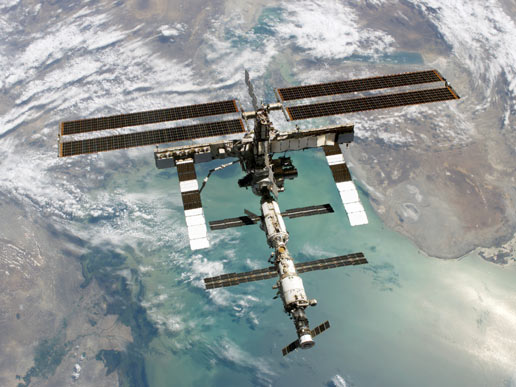
The International Space Station. Credit: NASA
Saturday, March 9, 2013

NASA RESEARCHES ALTERNATIVE JET FUEL
FROM: NASA
NASA Begins Flight Research Campaign Using Alternate Jet Fuel
WASHINGTON -- NASA researchers have begun a series of flights using the agency's DC-8 flying laboratory to study the effects of alternate biofuel on engine performance, emissions and aircraft-generated contrails at altitude.
The Alternative Fuel Effects on Contrails and Cruise Emissions (ACCESS) research involves flying the DC-8 as high as 40,000 feet while an instrumented NASA Falcon HU-25 aircraft trails behind at distances ranging from 300 feet to more than 10 miles.
"We believe this study will improve understanding of contrails formation and quantify potential benefits of renewable alternate fuels in terms of aviation's impact on the environment," said Ruben Del Rosario, manager of NASA's Fixed Wing Project.
ACCESS flight operations are being staged from NASA's Dryden Aircraft Operations Facility in Palmdale, Calif., and will take place mostly within restricted airspace over Edwards Air Force Base, Calif.
During the flights, the DC-8's four CFM56 engines will be powered by conventional JP-8 jet fuel, or a 50-50 blend of JP-8 and an alternative fuel of hydroprocessed esters and fatty acids that comes from camelina plants.
More than a dozen instruments mounted on the Falcon jet will characterize the soot and gases streaming from the DC-8, monitor the way exhaust plumes change in composition as they mix with air, and investigate the role emissions play in contrail formation.
Also, if weather conditions permit, the Falcon jet will trail commercial aircraft flying in the Southern California region, in coordination with air traffic controllers, to survey the exhaust emissions from a safe distance of 10 miles.
The flight campaign began Feb. 28 and is expected to take as long as three weeks to complete.
ACCESS follows a pair of Alternative Aviation Fuel Experiment studies conducted in 2009 and 2011 in which ground-based instruments measured the DC-8's exhaust emissions as the aircraft burned alternative fuels while parked on the ramp at the Palmdale facility.
A second phase of ACCESS flights is planned for 2014. It will capitalize on lessons learned from the 2013 flights and include a more extensive set of measurements.
The ACCESS study is a joint project involving researchers at Dryden, NASA's Glenn Research Center in Cleveland and NASA's Langley Research Center in Hampton, Va.
The Fixed Wing Project within the Fundamental Aeronautics Program of NASA's Aeronautics Research Mission Directorate manages ACCESS.
NASA Begins Flight Research Campaign Using Alternate Jet Fuel
WASHINGTON -- NASA researchers have begun a series of flights using the agency's DC-8 flying laboratory to study the effects of alternate biofuel on engine performance, emissions and aircraft-generated contrails at altitude.
The Alternative Fuel Effects on Contrails and Cruise Emissions (ACCESS) research involves flying the DC-8 as high as 40,000 feet while an instrumented NASA Falcon HU-25 aircraft trails behind at distances ranging from 300 feet to more than 10 miles.
"We believe this study will improve understanding of contrails formation and quantify potential benefits of renewable alternate fuels in terms of aviation's impact on the environment," said Ruben Del Rosario, manager of NASA's Fixed Wing Project.
ACCESS flight operations are being staged from NASA's Dryden Aircraft Operations Facility in Palmdale, Calif., and will take place mostly within restricted airspace over Edwards Air Force Base, Calif.
During the flights, the DC-8's four CFM56 engines will be powered by conventional JP-8 jet fuel, or a 50-50 blend of JP-8 and an alternative fuel of hydroprocessed esters and fatty acids that comes from camelina plants.
More than a dozen instruments mounted on the Falcon jet will characterize the soot and gases streaming from the DC-8, monitor the way exhaust plumes change in composition as they mix with air, and investigate the role emissions play in contrail formation.
Also, if weather conditions permit, the Falcon jet will trail commercial aircraft flying in the Southern California region, in coordination with air traffic controllers, to survey the exhaust emissions from a safe distance of 10 miles.
The flight campaign began Feb. 28 and is expected to take as long as three weeks to complete.
ACCESS follows a pair of Alternative Aviation Fuel Experiment studies conducted in 2009 and 2011 in which ground-based instruments measured the DC-8's exhaust emissions as the aircraft burned alternative fuels while parked on the ramp at the Palmdale facility.
A second phase of ACCESS flights is planned for 2014. It will capitalize on lessons learned from the 2013 flights and include a more extensive set of measurements.
The ACCESS study is a joint project involving researchers at Dryden, NASA's Glenn Research Center in Cleveland and NASA's Langley Research Center in Hampton, Va.
The Fixed Wing Project within the Fundamental Aeronautics Program of NASA's Aeronautics Research Mission Directorate manages ACCESS.
Friday, March 8, 2013
Thursday, March 7, 2013
Wednesday, March 6, 2013
Tuesday, March 5, 2013
Monday, March 4, 2013
Sunday, March 3, 2013
ESO 456-67

FROM: NASA
Hubble Observes Glowing, Fiery Shells of Gas
It may look like something from "The Lord of the Rings," but this fiery swirl is actually a planetary nebula known as ESO 456-67. Set against a backdrop of bright stars, the rust-colored object lies in the constellation of Sagittarius (The Archer), in the southern sky.
In this image of ESO 456-67, it is possible to see the various layers of material expelled by the central star. Each appears in a different hue - red, orange, yellow, and green-tinted bands of gas are visible, with clear patches of space at the heart of the nebula. It is not fully understood how planetary nebulae form such a wide variety of shapes and structures; some appear to be spherical, some elliptical, others shoot material in waves from their polar regions, some look like hourglasses or figures of eight, and others resemble large, messy stellar explosions - to name but a few.
Image Credit: ESA/Hubble and NASA
MARS MINING
FROM: NASA
NASA is developing the RASSOR mining robot to collect soil, or regolith, on the moon or Mars so it can be processed into rocket fuel, breathable air and other commodities. By using materials available at other locations in the solar system, astronauts don't have to carry it all from Earth.
Thursday, February 28, 2013
Wednesday, February 27, 2013
Tuesday, February 26, 2013
Monday, February 25, 2013
HOT FIRE TEST AT WALLOPS VIDEO
FROM: NASA, ORBITAL SCIENCES
Antares Hot Fire Test at Wallops
NASA commercial partner Orbital Sciences of Dulles, Va., successfully conducted an engine test of its Antares rocket Friday, Feb. 22, from Mid-Atlantic Regional Spaceport Pad-0A at NASA's Wallops Flight Facility, Va.
Sunday, February 24, 2013
ICESAT-2 MISSION LAUNCH SERVICER SELECTED
FROM: NASA
NASA Selects Launch Services for ICESat-2 Mission
CAPE CANAVERAL, Fla. -- NASA's Launch Services Program at the agency's Kennedy Space Center in Florida has selected United Launch Services, LLC of Englewood, Colo., to provide Delta II launch services for the Ice, Cloud and Land Elevation Satellite (ICESat)-2 mission, currently scheduled for July 2016.
A firm fixed-price launch service task order has been awarded under the indefinite-delivery, indefinite-quantity NASA Launch Services (NLS) II contract. NASA's total cost to launch ICESat-2 is $96.6 million, including payload processing, integrated services, telemetry, reimbursables and other launch support requirements.
The Delta II rocket will place the ICESat-2 spacecraft into a near-circular Earth polar orbit following liftoff from Space Launch Complex-2 at Vandenberg Air Force Base in California. ICESat-2 is a continuation of the global time series of precision ice topography measurements initiated by the first ICESat mission. ICESat-2 will measure changes in the elevation of the polar ice sheets to understand their contribution to current and future sea-level rise. It also will characterize polar-sea ice thicknesses and global vegetation heights to understand their connections to the Earth system.
Subcontractors performing work for United Launch Services include Pratt & Whitney Rocketdyne of Canoga Park, Calif., Alliant Techsystems, Inc of Magna, Utah and Aerojet of Sacramento, Calif. United Launch Services' United Launch Alliance provides the Delta II and launch services.
NASA's Launch Services Program at Kennedy Space Center is responsible for management of the ICESat-2 launch service acquisition and implementation.
NASA Selects Launch Services for ICESat-2 Mission
CAPE CANAVERAL, Fla. -- NASA's Launch Services Program at the agency's Kennedy Space Center in Florida has selected United Launch Services, LLC of Englewood, Colo., to provide Delta II launch services for the Ice, Cloud and Land Elevation Satellite (ICESat)-2 mission, currently scheduled for July 2016.
A firm fixed-price launch service task order has been awarded under the indefinite-delivery, indefinite-quantity NASA Launch Services (NLS) II contract. NASA's total cost to launch ICESat-2 is $96.6 million, including payload processing, integrated services, telemetry, reimbursables and other launch support requirements.
The Delta II rocket will place the ICESat-2 spacecraft into a near-circular Earth polar orbit following liftoff from Space Launch Complex-2 at Vandenberg Air Force Base in California. ICESat-2 is a continuation of the global time series of precision ice topography measurements initiated by the first ICESat mission. ICESat-2 will measure changes in the elevation of the polar ice sheets to understand their contribution to current and future sea-level rise. It also will characterize polar-sea ice thicknesses and global vegetation heights to understand their connections to the Earth system.
Subcontractors performing work for United Launch Services include Pratt & Whitney Rocketdyne of Canoga Park, Calif., Alliant Techsystems, Inc of Magna, Utah and Aerojet of Sacramento, Calif. United Launch Services' United Launch Alliance provides the Delta II and launch services.
NASA's Launch Services Program at Kennedy Space Center is responsible for management of the ICESat-2 launch service acquisition and implementation.
Subscribe to:
Posts (Atom)