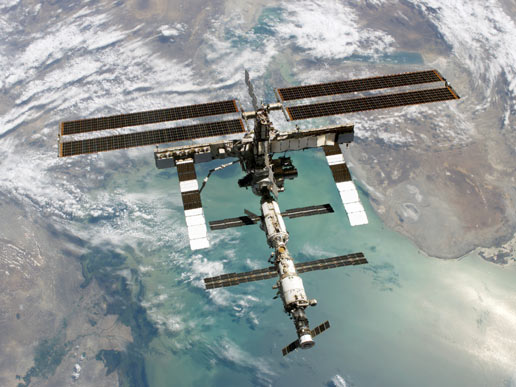
The International Space Station. Credit: NASA
Wednesday, August 21, 2013

Tuesday, August 20, 2013
Sunday, August 18, 2013
TESTING BEFORE TELESCOPE'S ASSEMBLY

FROM: NASA
Dropping in on a James Webb Space Telescope Clean Room Test
The James Webb Space Telescope is a large space telescope, optimized for infrared wavelengths. It is scheduled for launch later in this decade. Webb will find the first galaxies that formed in the early Universe, connecting the Big Bang to our own Milky Way galaxy. Webb will peer through dusty clouds to see stars forming planetary systems, connecting the Milky Way to our own solar system. Webb's instruments will be designed to work primarily in the infrared range of the electromagnetic spectrum, with some capability in the visible range.
Webb will have a large mirror, 6.5 meters (21.3 feet) in diameter, and a sunshield the size of a tennis court. The mirror and sunshade won't fit into a rocket fully open, so both will be folded and open once Webb is in outer space. Webb will reside in an orbit about 1.5 million km (1 million miles) from Earth at the second Lagrange point.
The James Webb Space Telescope was named after a former NASA administrator.
Thursday, August 15, 2013
Wednesday, August 14, 2013
Monday, August 12, 2013
Sunday, August 11, 2013
Saturday, August 10, 2013
Friday, August 9, 2013
Wednesday, August 7, 2013
Subscribe to:
Posts (Atom)