FROM: NASA
NASA astronauts Rick Mastracchio and Mike Hopkins completed a 5 hour and 28 minute spacewalk Saturday to remove a faulty ammonia pump on the International Space Station. A second spacewalk to install a new unit now is scheduled for Tuesday, Dec. 24.
The extra day will allow time for the crew to resize a spare spacesuit on the space station for use by Mastracchio. During repressurization of the station’s airlock following the spacewalk, a spacesuit configuration issue put the suit Mastracchio was wearing in question for the next excursion -- specifically whether water entered into the suit’s sublimator inside the airlock. The flight control team at NASA's Johnson Space Center in Houston decided to switch to a backup suit for the next spacewalk.
This issue is not related to the spacesuit water leak that was seen during a July spacewalk by European Space Agency astronaut Luca Parmitano and NASA’s Chris Cassidy. Both Mastracchio and Hopkins reported dry conditions repeatedly throughout Saturday’s activities and the two were never in danger.
NASA Television coverage of Tuesday’s spacewalk will begin at 6:15 a.m. EST. The spacewalk scheduled to begin at 7:10 a.m.
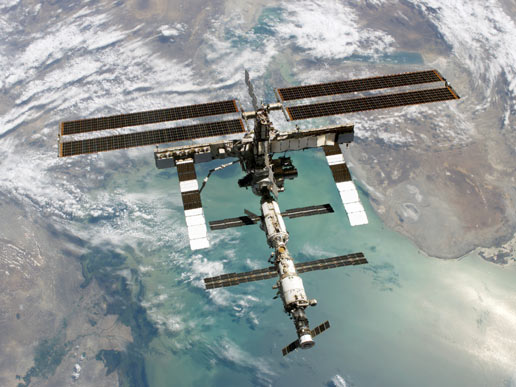
The International Space Station. Credit: NASA
Tuesday, December 24, 2013

Sunday, December 22, 2013
ROCKET PREPPED FOR LAUNCH ON RESUPPLY MISSION TO ISS

An Orbital Science Corporation Antares rocket is seen on Tuesday, Dec. 16, 2013 as it is rolled out to launch Pad-0A at NASA's Wallops Flight Facility in Wallops Island, VA. The Antares is scheduled to launch a Cygnus spacecraft on a cargo resupply mission to the International Space Station on Thursday, Dec. 19 at 9:19 p.m. EST. The Orbital-1 mission is Orbital Sciences' first contracted cargo delivery flight to the space station for NASA. Among the cargo aboard Cygnus set to launch to the space station are science experiments, crew provisions, spare parts and other hardware. Weather permitting, it may be widely visible along the east coast of the United States. > Map of Orbital-1 Launch Viewing Image Credit: NASA/Bill Ingalls
Thursday, December 19, 2013
Wednesday, December 18, 2013
Tuesday, December 17, 2013
Sunday, December 15, 2013
A LOOK AT THE YELLOWKNIFE ON MARS

Yellowknife Bay Formation on Mars
This mosaic of images from Curiosity's Mast Camera (Mastcam) shows geological members of the Yellowknife Bay formation. The scene has the Sheepbed mudstone in the foreground and rises up through Gillespie Lake member to the Point Lake outcrop. These rocks record superimposed ancient lake and stream deposits that offered past environmental conditions favorable for microbial life. Rocks here were exposed about 70 million years ago by removal of overlying layers due to erosion by the wind.
The scene is a portion of a 111-image mosaic acquired during the 137th Martian day, or sol, of Curiosity's work on Mars (Dec. 24, 2012). The foothills of Mount Sharp are visible in the distance, upper left, southwest of camera position. Image Credit: NASA-JPL-Caltech-MSSS
Saturday, December 14, 2013
Friday, December 13, 2013
Wednesday, December 11, 2013
Tuesday, December 10, 2013
Monday, December 9, 2013
Sunday, December 8, 2013
NANOSATELLITES LAUNCHED FROM SPACE STATION

ISS038-E-003872 (19 Nov. 2013) --- Three nanosatellites, known as Cubesats, are deployed from a Small Satellite Orbital Deployer (SSOD) attached to the Kibo laboratory’s robotic arm at 7:10 a.m. (EST) on Nov. 19, 2013. Japan Aerospace Exploration Agency astronaut Koichi Wakata, Expedition 38 flight engineer, monitored the satellite deployment while operating the Japanese robotic arm from inside Kibo. The Cubesats were delivered to the International Space Station Aug. 9, aboard Japan’s fourth H-II Transfer Vehicle, Kounotori-4. Credit: NASA
Saturday, December 7, 2013
Subscribe to:
Posts (Atom)