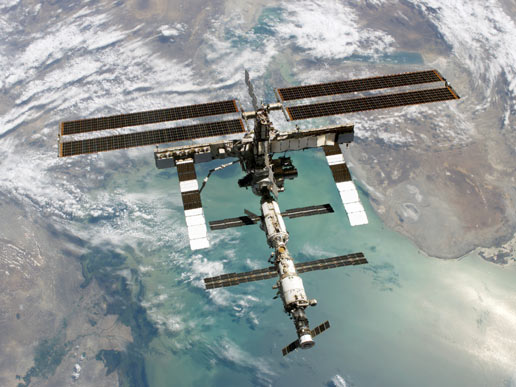
The International Space Station. Credit: NASA
Thursday, March 20, 2014

Wednesday, March 19, 2014
Monday, March 17, 2014
Sunday, March 16, 2014
ICE RETREATS AT THE MARTIAN DUNES DURING MARTIAN SPRING

Mars’ northern-most sand dunes are beginning to emerge from their winter cover of seasonal carbon dioxide (dry) ice. Dark, bare south-facing slopes are soaking up the warmth of the sun. The steep lee sides of the dunes are also ice-free along the crest, allowing sand to slide down the dune. Dark splotches are places where ice cracked earlier in spring, releasing sand. Soon the dunes will be completely bare and all signs of spring activity will be gone.
This image was acquired by the HiRISE camera aboard NASA's Mars Reconnaissance Orbiter on Jan. 16, 2014. The University of Arizona, Tucson, operates the HiRISE camera, which was built by Ball Aerospace & Technologies Corp., Boulder, Colo. NASA's Jet Propulsion Laboratory, a division of the California Institute of Technology in Pasadena, manages the Mars Reconnaissance Orbiter Project for the NASA Science Mission Directorate, Washington. > More information and image products Image Credit: NASA/JPL-Caltech/Univ. of Arizona Caption: Candy Hansen.
Friday, March 14, 2014
Thursday, March 13, 2014
Tuesday, March 11, 2014
Monday, March 10, 2014
Sunday, March 9, 2014
SUN EMITS "SIGNIFICANT SOLAR FLARE"

On Feb. 24, 2014, the sun emitted a significant solar flare, peaking at 7:49 p.m. EST. NASA's Solar Dynamics Observatory (SDO), which keeps a constant watch on the sun, captured images of the event. These SDO images from 7:25 p.m. EST on Feb. 24 show the first moments of this X-class flare in different wavelengths of light -- seen as the bright spot that appears on the left limb of the sun. Hot solar material can be seen hovering above the active region in the sun's atmosphere, the corona. Solar flares are powerful bursts of radiation, appearing as giant flashes of light in the SDO images. Harmful radiation from a flare cannot pass through Earth's atmosphere to physically affect humans on the ground, however -- when intense enough -- they can disturb the atmosphere in the layer where GPS and communications signals travel. > Read more Image Credit: NASA/SDO.
Saturday, March 8, 2014
Friday, March 7, 2014
Thursday, March 6, 2014
Wednesday, March 5, 2014
Subscribe to:
Posts (Atom)