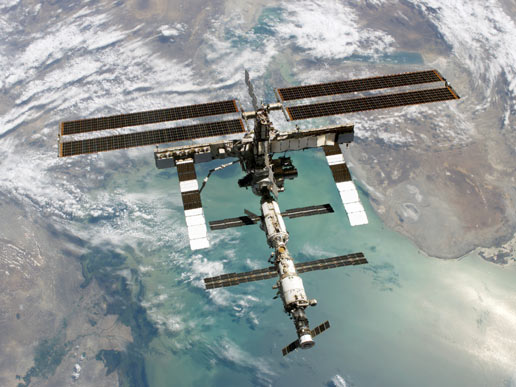
The International Space Station. Credit: NASA
Wednesday, June 11, 2014

Sunday, June 8, 2014
WHERE THE WATER MEETS THE LAND IN THE WESTERN SAHARA

On May 23, 2014, Expedition 40 Commander Steve Swanson posted this photograph -- taken from the International Space Station -- to Instagram. Swanson noted, “Western Sahara – the contrast between the sand and the water is spectacular from here.” Swanson uploaded the first image from space to Instagram on April 7. He began posting imagery to the social media site during his pre-flight training. › View Instagram imagery from the International Space Station The three Expedition 40 crew members aboard the International Space Station worked advanced science this week while awaiting a new trio, set to lift off on Wednesday, May 28. Soyuz Commander and cosmonaut Maxim Suraev, NASA astronaut Reid Wiseman and European astronaut Alexander Gerst will launch aboard the Soyuz TMA-13M spacecraft at 3:57 p.m. EDT (1:57 a.m. May 29 Baikonur time) from the Baikonur Cosmodrome. Image Credit: NASA
Saturday, June 7, 2014
Sunday, June 1, 2014
EXPEDITION 40 SOYUZ TMA-13M ROCKET LAUNCHES TO ISS
FROM: NASA SOYUZ

The Soyuz TMA-13M rocket is launched with Expedition 40 Soyuz Commander Maxim Suraev, of the Russian Federal Space Agency, Roscosmos, Flight Engineer Alexander Gerst, of the European Space Agency, ESA, and Flight Engineer Reid Wiseman of NASA in the early hours of Thursday, May 29, 2014 at the Baikonur Cosmodrome in Kazakhstan. Suraev, Gerst, and Wiseman will spend the next five and a half months aboard the International Space Station. Image Credit-NASA-Joel Kowsky
Saturday, May 31, 2014
Friday, May 30, 2014
Thursday, May 29, 2014
Wednesday, May 28, 2014
Sunday, May 25, 2014
A CANYON GRANDER THAN THE GRAND CANYON

Valles Marineris: The Grand Canyon of Mars: Explanation: The largest canyon in the Solar System cuts a wide swath across the face of Mars. Named Valles Marineris, the grand valley extends over 3,000 kilometers long, spans as much as 600 kilometers across, and delves as much as 8 kilometers deep. By comparison, the Earth's Grand Canyon in Arizona, USA is 800 kilometers long, 30 kilometers across, and 1.8 kilometers deep. The origin of the Valles Marineris remains unknown, although a leading hypothesis holds that it started as a crack billions of years ago as the planet cooled. Several geologic processes have been identified in the canyon. The above mosaic was created from over 100 images of Mars taken by Viking Orbiters in the 1970s. Image and story credit: Viking Project, USGS, NASA.
Saturday, May 24, 2014
Friday, May 23, 2014
Thursday, May 22, 2014
Wednesday, May 21, 2014
Subscribe to:
Posts (Atom)