FROM: NASA
The destructive results of a powerful supernova explosion reveal themselves in a delicate tapestry of X-ray light, as seen in this image from NASA’s Chandra X-Ray Observatory and the European Space Agency's XMM-Newton. The image shows the remains of a supernova that would have been witnessed on Earth about 3,700 years ago. The remnant is called Puppis A, and is around 7,000 light years away and about 10 light years across. This image provides the most complete and detailed X-ray view of Puppis A ever obtained, made by combining a mosaic of different Chandra and XMM-Newton observations. Low-energy X-rays are shown in red, medium-energy X-rays are in green and high energy X-rays are colored blue. These observations act as a probe of the gas surrounding Puppis A, known as the interstellar medium. The complex appearance of the remnant shows that Puppis A is expanding into an interstellar medium that probably has a knotty structure. Supernova explosions forge the heavy elements that can provide the raw material from which future generations of stars and planets will form. Studying how supernova remnants expand into the galaxy and interact with other material provides critical clues into our own origins. A paper describing these results was published in the July 2013 issue of Astronomy and Astrophysics and is available online. The first author is Gloria Dubner from the Instituto de Astronomía y Física del Espacio in Buenos Aires in Argentina. Image credit: NASA/CXC/IAFE/G.Dubner et al & ESA/XMM-Newton.
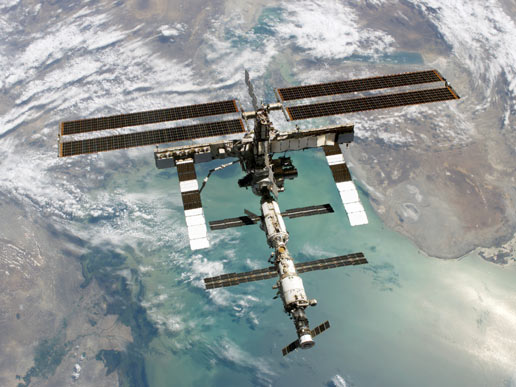
The International Space Station. Credit: NASA
Sunday, November 23, 2014
Friday, November 21, 2014
Thursday, November 20, 2014
Wednesday, November 19, 2014
Tuesday, November 18, 2014
Monday, November 17, 2014
Sunday, November 16, 2014
BUILDING THE TOOLS TO BUILD THE NEXT SPACECRAFT
FROM: NASA
Caption and Image Credit: NASA. World's Largest Spacecraft Welding Tool for Space Launch System-The largest spacecraft welding tool in the world, the Vertical Assembly Center, officially is open for business at NASA's Michoud Assembly Facility in New Orleans. The 170-foot-tall, 78-foot-wide giant completes a world-class welding toolkit that will be used to build the core stage of America's next great rocket, the Space Launch System (SLS).
SLS will be the most powerful rocket ever built for deep space missions, including to an asteroid and eventually Mars. The core stage, towering more than 200 feet tall (61 meters) with a diameter of 27.6 feet (8.4 meters), will store cryogenic liquid hydrogen and liquid oxygen that will feed the rocket's RS-25 engines.
The Vertical Assembly Center is part of a family of state-of-the-art tools designed to weld the core stage of SLS. It will join domes, rings and barrels to complete the tanks or dry structure assemblies. It also will be used to perform evaluations on the completed welds. Boeing is the prime contractor for the SLS core stage, including avionics.
Caption and Image Credit: NASA. World's Largest Spacecraft Welding Tool for Space Launch System-The largest spacecraft welding tool in the world, the Vertical Assembly Center, officially is open for business at NASA's Michoud Assembly Facility in New Orleans. The 170-foot-tall, 78-foot-wide giant completes a world-class welding toolkit that will be used to build the core stage of America's next great rocket, the Space Launch System (SLS).
SLS will be the most powerful rocket ever built for deep space missions, including to an asteroid and eventually Mars. The core stage, towering more than 200 feet tall (61 meters) with a diameter of 27.6 feet (8.4 meters), will store cryogenic liquid hydrogen and liquid oxygen that will feed the rocket's RS-25 engines.
The Vertical Assembly Center is part of a family of state-of-the-art tools designed to weld the core stage of SLS. It will join domes, rings and barrels to complete the tanks or dry structure assemblies. It also will be used to perform evaluations on the completed welds. Boeing is the prime contractor for the SLS core stage, including avionics.
Saturday, November 15, 2014
Friday, November 14, 2014
Thursday, November 13, 2014
Subscribe to:
Comments (Atom)

