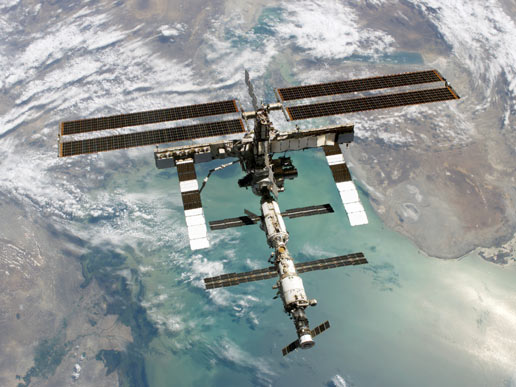
The International Space Station. Credit: NASA
Wednesday, December 10, 2014

Tuesday, December 9, 2014
Monday, December 8, 2014
Sunday, December 7, 2014
Saturday, December 6, 2014
Friday, December 5, 2014
Thursday, December 4, 2014
Wednesday, December 3, 2014
Tuesday, December 2, 2014
Sunday, November 30, 2014
SUN SPOTS IN THE ULTRA EXTREME
FROM: NASA

The sun emitted a significant solar flare on Oct. 19, 2014, peaking at 1:01 a.m. EDT. NASA's Solar Dynamics Observatory, which is always observing the sun, captured this image of the event in extreme ultraviolet wavelength of 131 Angstroms – a wavelength that can see the intense heat of a flare and that is typically colorized in teal. This flare is classified as an X1.1-class flare. X-class denotes the most intense flares, while the number provides more information about its strength. An X2 flare is twice as intense as an X1, and an X3 is three times as intense. Solar flares are powerful bursts of radiation. Harmful radiation from a flare cannot pass through Earth's atmosphere to physically affect humans on the ground, however -- when intense enough -- they can disturb the atmosphere in the layer where GPS and communications signals travel. > More: NASA's SDO Observes an X-class Solar Flare. Image Credit-NASA-Solar Dynamics Observatory.
Wednesday, November 26, 2014
Monday, November 24, 2014
SOYUZ ROCKET ROLLS OUT

Caption Credit: NASA. Expedition 42 Soyuz Rocket Rolls Out. The Soyuz TMA-15M spacecraft is rolled out to the launch pad by train on Friday, Nov. 21, 2014 at the Baikonur Cosmodrome in Kazakhstan. Launch of the Soyuz rocket is scheduled for Nov. 24 and will carry Expedition 42 Soyuz Commander Anton Shkaplerov of the Russian Federal Space Agency (Roscosmos), Flight Engineer Terry Virts of NASA , and Flight Engineer Samantha Cristoforetti of the European Space Agency into orbit to begin their five and a half month mission on the International Space Station. Image Credit: NASA/Aubrey Gemignani.
Subscribe to:
Posts (Atom)