Dr. Eric Furst from the University of Delaware joins NASA Public Affairs Officer Kelly Humphries in the Mission Control Center in Houston via telephone to discuss the InSpace-3 experiment taking place aboard the International Space Station
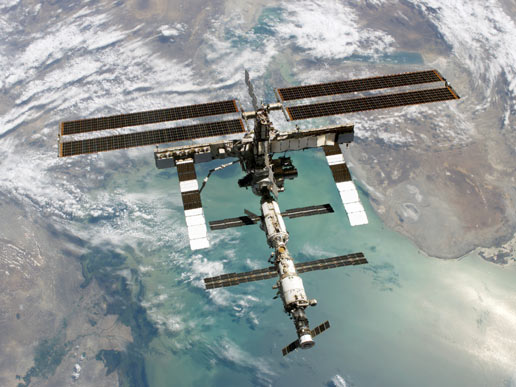
The International Space Station. Credit: NASA
Sunday, February 3, 2013
NASA VIDEO: STUDYING SMART FLUIDS IN SPACE
FROM: NASA
ISS Update: Studying Smart Fluids in Space
Dr. Eric Furst from the University of Delaware joins NASA Public Affairs Officer Kelly Humphries in the Mission Control Center in Houston via telephone to discuss the InSpace-3 experiment taking place aboard the International Space Station
Dr. Eric Furst from the University of Delaware joins NASA Public Affairs Officer Kelly Humphries in the Mission Control Center in Houston via telephone to discuss the InSpace-3 experiment taking place aboard the International Space Station

Saturday, February 2, 2013
THE DEAD STAR

FROM: NASA
Sizzling Remains of a Dead Star
This new view of the historical supernova remnant Cassiopeia A, located 11,000 light-years away, was taken by NASA's Nuclear Spectroscopic Telescope Array, or NuSTAR. Blue indicates the highest energy X-ray light, where NuSTAR has made the first resolved image ever of this source. Red and green show the lower end of NuSTAR's energy range, which overlaps with NASA's high-resolution Chandra X-ray Observatory.
Light from the stellar explosion that created Cassiopeia A is thought to have reached Earth about 300 years ago, after traveling 11,000 years to get here. While the star is long dead, its remains are still bursting with action. The outer blue ring is where the shock wave from the supernova blast is slamming into surrounding material, whipping particles up to within a fraction of a percent of the speed of light. NuSTAR observations should help solve the riddle of how these particles are accelerated to such high energies
X-ray light with energies between 10 and 20 kiloelectron volts are blue; X-rays of 8 to 10 kiloelectron volts are green; and X-rays of 4.5 to 5.5 kiloelectron volts are red.
The starry background picture is from the Digitized Sky Survey.
Image credit: NASA/JPL-Caltech/DSS
TDRS-K LAUNCH CLOSE-UP
FROM: NASA
Close-up Views of TDRS-K Launch
See multiple views of the Atlas V launch of the TDRS-K spacecraft
Close-up Views of TDRS-K Launch
See multiple views of the Atlas V launch of the TDRS-K spacecraft
Friday, February 1, 2013
Thursday, January 31, 2013
Tuesday, January 29, 2013
Monday, January 28, 2013
Friday, January 25, 2013
Thursday, January 24, 2013
Wednesday, January 23, 2013
Tuesday, January 22, 2013
Sunday, January 20, 2013
ROBONAUT 2 TRAINING TO BE PART OF THE SPACE CREW

FROM: NASA
Robonaut Operates Task Board in Space
In the International Space Station's Destiny laboratory, Robonaut 2 is pictured on Jan. 2, during a round of testing for the first humanoid robot in space. Ground teams put Robonaut through its paces as they remotely commanded it to operate valves on a task board.
Robonaut is a testbed for exploring new robotic capabilities in space, and its form and dexterity allow it to use the same tools and control panels as its human counterparts do aboard the station.
Photo Credit: NASA
Saturday, January 19, 2013
THE MARTIAN BULGE

FROM: NASA
Thermal Tides at Mars
This diagram illustrates Mars' "thermal tides," a weather phenomenon responsible for large, daily variations in pressure at the Martian surface. Sunlight heats the surface and atmosphere on the day side of the planet, causing air to expand upwards. At higher levels in the atmosphere, this bulge of air then expands outward, to the sides, in order to equalize the pressure around it, as shown by the red arrows. Air flows out of the bulge, lowering the pressure of air felt at the surface below the bulge. The result is a deeper atmosphere, but one that is less dense and has a lower pressure at the surface, than that on the night side of the planet. As Mars rotates beneath the sun, this bulge moves across the planet each day, from east to west. A fixed observer, such as NASA's Curiosity rover, measures a decrease in pressure during the day, followed by an increase in pressure at night. The precise timing of the increase and decrease are affected by the time it takes the atmosphere to respond to the sunlight, as well as a number of other factors including the shape of the planet's surface and the amount of dust in the atmosphere.
Image credit: NASA/JPL-Caltech/Ashima Research/SWRI
Wednesday, January 16, 2013
Subscribe to:
Posts (Atom)