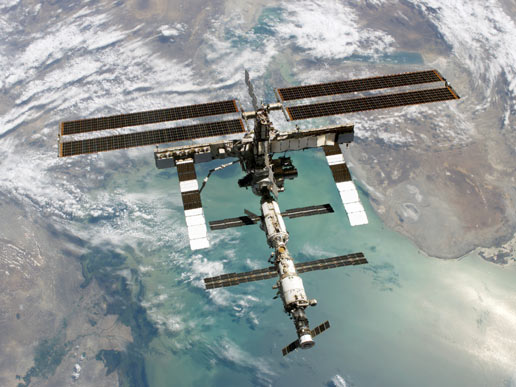
The International Space Station. Credit: NASA
Tuesday, March 4, 2014
Monday, March 3, 2014
Sunday, March 2, 2014
LAUNCH OF THE H-IIA WITH GPM CORE OBSERVATORY
FROM: NASA
H-IIA ROCKET ROLLS OUT AT TANEGASHIMA SPACE CENTER, JAPAN
A Japanese H-IIA rocket carrying the NASA-Japan Aerospace Exploration Agency (JAXA) Global Precipitation Measurement (GPM) Core Observatory rolls out to launch pad 1 at the Tanegashima Space Center, Thursday, Feb. 27, 2014, Tanegashima, Japan. Once launched, the GPM spacecraft will collect information that unifies data from an international network of existing and future satellites to map global rainfall and snowfall every three hours. The rocket is scheduled to lift off during a launch window that opens at 1:37 p.m. EST on Thursday, Feb. 27 (3:37 a.m., Friday, Feb. 28 Japan time). GPM is an international satellite mission to provide next-generation observations of rain and snow worldwide every three hours. The GPM Core Observatory satellite carries advanced instruments that will set a new standard for precipitation measurements from space. The data they provide will be used to unify precipitation measurements made by an international network of partner satellites to quantify when, where, and how much it rains or snows around the world. The GPM mission will help advance our understanding of Earth's water and energy cycles, improve the forecasting of extreme events that cause natural disasters, and extend current capabilities of using satellite precipitation information to directly benefit society. Image Credit-NASA-Bill Ingalls.
JAPANESE H-IIA ROCKET LAUNCHES FROM TANEGASHIMA SPACE CENTER
A Japanese H-IIA rocket with the NASA-Japan Aerospace Exploration Agency (JAXA), Global Precipitation Measurement (GPM) Core Observatory onboard, is seen launching from the Tanegashima Space Center on Friday, Feb. 28, 2014 (Japan Time), in Tanegashima, Japan. The GPM spacecraft will collect information that unifies data from an international network of existing and future satellites to map global rainfall and snowfall every three hours. Image Credit-NASA-Bill Ingalls.
H-IIA ROCKET ROLLS OUT AT TANEGASHIMA SPACE CENTER, JAPAN
A Japanese H-IIA rocket carrying the NASA-Japan Aerospace Exploration Agency (JAXA) Global Precipitation Measurement (GPM) Core Observatory rolls out to launch pad 1 at the Tanegashima Space Center, Thursday, Feb. 27, 2014, Tanegashima, Japan. Once launched, the GPM spacecraft will collect information that unifies data from an international network of existing and future satellites to map global rainfall and snowfall every three hours. The rocket is scheduled to lift off during a launch window that opens at 1:37 p.m. EST on Thursday, Feb. 27 (3:37 a.m., Friday, Feb. 28 Japan time). GPM is an international satellite mission to provide next-generation observations of rain and snow worldwide every three hours. The GPM Core Observatory satellite carries advanced instruments that will set a new standard for precipitation measurements from space. The data they provide will be used to unify precipitation measurements made by an international network of partner satellites to quantify when, where, and how much it rains or snows around the world. The GPM mission will help advance our understanding of Earth's water and energy cycles, improve the forecasting of extreme events that cause natural disasters, and extend current capabilities of using satellite precipitation information to directly benefit society. Image Credit-NASA-Bill Ingalls.
JAPANESE H-IIA ROCKET LAUNCHES FROM TANEGASHIMA SPACE CENTER
A Japanese H-IIA rocket with the NASA-Japan Aerospace Exploration Agency (JAXA), Global Precipitation Measurement (GPM) Core Observatory onboard, is seen launching from the Tanegashima Space Center on Friday, Feb. 28, 2014 (Japan Time), in Tanegashima, Japan. The GPM spacecraft will collect information that unifies data from an international network of existing and future satellites to map global rainfall and snowfall every three hours. Image Credit-NASA-Bill Ingalls.
Saturday, March 1, 2014
Friday, February 28, 2014
Thursday, February 27, 2014
Wednesday, February 26, 2014
Tuesday, February 25, 2014
Monday, February 24, 2014
Sunday, February 23, 2014
GALAXY SHOCK
FROM: NASA
Roguish runaway stars can have a big impact on their surroundings as they plunge through the Milky Way galaxy. Their high-speed encounters shock the galaxy, creating arcs, as seen in this newly released image from NASA’s Spitzer Space Telescope. In this case, the speedster star is known as Kappa Cassiopeiae, or HD 2905 to astronomers. It is a massive, hot supergiant moving at around 2.5 million mph relative to its neighbors (1,100 kilometers per second). But what really makes the star stand out in this image is the surrounding, streaky red glow of material in its path. Such structures are called bow shocks, and they can often be seen in front of the fastest, most massive stars in the galaxy. Bow shocks form where the magnetic fields and wind of particles flowing off a star collide with the diffuse, and usually invisible, gas and dust that fill the space between stars. How these shocks light up tells astronomers about the conditions around the star and in space. Slow-moving stars like our sun have bow shocks that are nearly invisible at all wavelengths of light, but fast stars like Kappa Cassiopeiae create shocks that can be seen by Spitzer’s infrared detectors. Image Credit-NASA-JPL-Caltech
Subscribe to:
Comments (Atom)


