At about 89,000 miles in diameter, Jupiter could swallow 1,000 Earths. It is the largest planet in the solar system and perhaps the most majestic. Vibrant bands of clouds carried by winds that can exceed 400 mph continuously circle the planet's atmosphere. Such winds sustain spinning anticyclones like the Great Red Spot -- a raging storm three and a half times the size of Earth located in Jupiter’s southern hemisphere. In January and February 1979, NASA's Voyager 1 spacecraft zoomed toward Jupiter, capturing hundreds of images during its approach, including this close-up of swirling clouds around Jupiter's Great Red Spot. This image was assembled from three black and white negatives. The observations revealed many unique features of the planet that are still being explored to this day. > View more images and watch a time-lapse of Jupiter assembled from images taken by the spacecraft Credit: NASA's Goddard Space Flight Center. Images courtesy of NASA-JPL
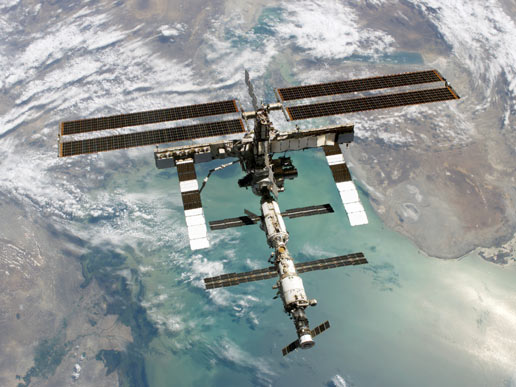
The International Space Station. Credit: NASA
Sunday, April 13, 2014
THE BIG SPOT ON JUPITER
FROM: NASA
At about 89,000 miles in diameter, Jupiter could swallow 1,000 Earths. It is the largest planet in the solar system and perhaps the most majestic. Vibrant bands of clouds carried by winds that can exceed 400 mph continuously circle the planet's atmosphere. Such winds sustain spinning anticyclones like the Great Red Spot -- a raging storm three and a half times the size of Earth located in Jupiter’s southern hemisphere. In January and February 1979, NASA's Voyager 1 spacecraft zoomed toward Jupiter, capturing hundreds of images during its approach, including this close-up of swirling clouds around Jupiter's Great Red Spot. This image was assembled from three black and white negatives. The observations revealed many unique features of the planet that are still being explored to this day. > View more images and watch a time-lapse of Jupiter assembled from images taken by the spacecraft Credit: NASA's Goddard Space Flight Center. Images courtesy of NASA-JPL
Friday, April 11, 2014
Wednesday, April 9, 2014
Monday, April 7, 2014
Sunday, April 6, 2014
CELEBRATING HUBBLE ON 24TH ANNIVERSARY OF LAUNCH
FROM: NASA
In celebration of the 24th anniversary of the launch of NASA's Hubble Space Telescope, astronomers have captured infrared-light images of a churning region of star birth 6,400 light-years away. This colorful Hubble Space Telescope mosaic of a small portion of the Monkey Head Nebula unveils a collection of carved knots of gas and dust silhouetted against glowing gas. The cloud is sculpted by ultraviolet light eating into the cool hydrogen gas. Image Credit: NASA, ESA, and the Hubble Heritage Team (STScI/AURA).
Saturday, April 5, 2014
Friday, April 4, 2014
Thursday, April 3, 2014
Wednesday, April 2, 2014
Tuesday, April 1, 2014
Monday, March 31, 2014
Sunday, March 30, 2014
ADRIFT IN ORION'S STELLAR NURSERY..."
FROM: NASA
This esthetic close-up of cosmic clouds and stellar winds features LL Orionis, interacting with the Orion Nebula flow. Adrift in Orion's stellar nursery and still in its formative years, variable star LL Orionis produces a wind more energetic than the wind from our own middle-aged Sun. As the fast stellar wind runs into slow moving gas a shock front is formed, analogous to the bow wave of a boat moving through water or a plane traveling at supersonic speed. The small, arcing, graceful structure just above and left of center is LL Ori's cosmic bow shock, measuring about half a light-year across. The slower gas is flowing away from the Orion Nebula's hot central star cluster, the Trapezium, located off the upper left corner of the picture. In three dimensions, LL Ori's wrap-around shock front is shaped like a bowl that appears brightest when viewed along the "bottom" edge. The beautiful picture is part of a large mosaic view of the complex stellar nursery in Orion, filled with a myriad of fluid shapes associated with star formation. Image Credit: NASA, ESA and the Hubble Heritage Team.
Subscribe to:
Comments (Atom)


