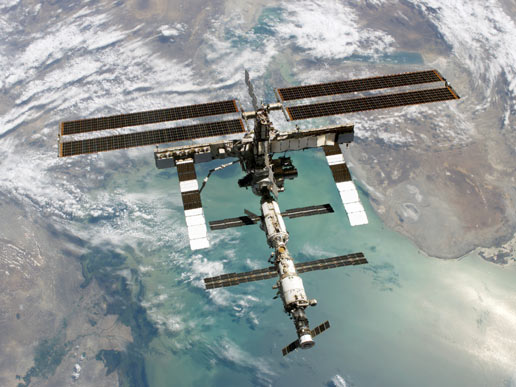
The International Space Station. Credit: NASA
Saturday, June 13, 2015

Friday, June 12, 2015
Wednesday, June 10, 2015
Tuesday, June 9, 2015
Monday, June 8, 2015
Sunday, June 7, 2015
MARS SURFACE FROM SPACE
FROM: NASA
 |
| This image of a circular depression on the surface of Mars was acquired on Jan. 5, 2015 by the High Resolution Imaging Science Experiment (HiRISE) camera on NASA's Mars Reconnaissance Orbiter (MRO). The spacecraft has been orbiting Mars since March 2006 and completed its 40,000th orbit around Mars on Feb. 7, 2015. The target of this observation is a circular depression in a dark-toned unit associated with a field of cones to the northeast. At the scale of an image taken by MRO's Context Camera, which provides wide area views to provide context for high-resolution analysis, the depression appears to expose layers especially on the sides or walls, which are overlain by dark sands presumably associated with the dark-toned unit. The HiRISE camera's resolution, which is far higher than that of the Context Camera and its larger footprint, can help identify possible layers. HiRISE is one of six instruments on the Mars Reconnaissance Orbiter. The University of Arizona, Tucson, operates HiRISE, which was built by Ball Aerospace & Technologies Corp., Boulder, Colo. NASA's Jet Propulsion Laboratory, a division of the California Institute of Technology in Pasadena, manages the Mars Reconnaissance Orbiter Project for NASA's Science Mission Directorate, Washington. Image Credit-NASA-JPL-Caltech-University of Arizona. |
Friday, June 5, 2015
Tuesday, June 2, 2015
Sunday, May 31, 2015
WHERE ARE THE WORLDS WITH WATER?

As NASA missions explore our solar system and search for new worlds, they are finding water in surprising places. Water is but one piece of our search for habitable planets and life beyond Earth, yet it links many seemingly unrelated worlds in surprising ways. Perhaps the most surprising water worlds are the five icy moons of Jupiter and Saturn that show strong evidence of oceans beneath their surfaces: Ganymede, Europa and Callisto at Jupiter, and Enceladus and Titan at Saturn. Scientists using NASA's Hubble Space Telescope recently provided powerful evidence that Ganymede has a saltwater, sub-surface ocean, likely sandwiched between two layers of ice. In this artist’s concept, the moon Ganymede orbits the giant planet Jupiter. The Hubble Space Telescope observed aurorae on the moon generated by Ganymede’s magnetic fields. A saline ocean under the moon’s icy crust best explains shifting in the auroral belts measured by Hubble. More: The Solar System and Beyond is Awash in Water Image Credit: NASA/ESA.
Saturday, May 30, 2015
Friday, May 29, 2015
Thursday, May 28, 2015
Subscribe to:
Posts (Atom)